
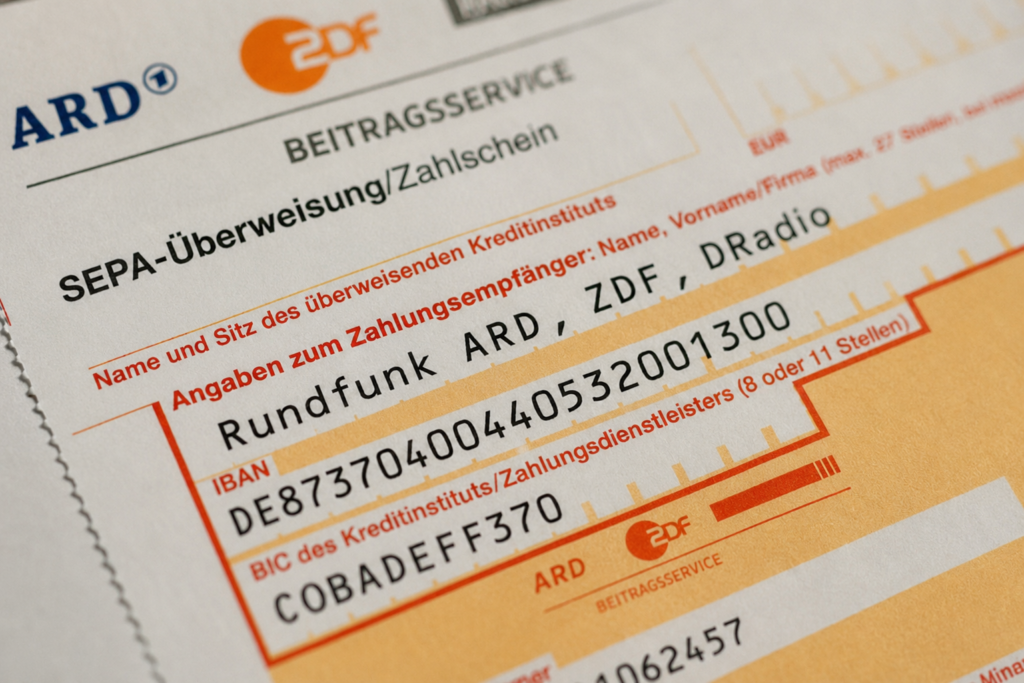
One of the first letters many people receive after registering their address in Germany is via Anmeldung it is not from the tax office or immigration, but from the Contributions Service, requesting payment of the Broadcasting contribution.
Many newcomers believe it's a scam or that they don't have to pay because they don't watch German television. Unfortunately, it doesn't work like that.
Please be aware that failure to pay this contribution may lead to significant problems in Germany. Many people think it's not a serious matter, but believe us: it is. Ignoring the Broadcasting contribution may result in late charges, debt collection procedures, and even legal action.
In this, we explain who should pay it, how much it costs, how to register, what happens if you ignore the letters, and who can apply for an exemption.
What is the Rundfunkbeitrag?
Before anything else, let's see what the word really means Broadcasting contribution. Literally translated, it means Contribution to broadcasting. It was formerly known as Broadcasting Contribution (Broadcasting Fee Enforcement Centre) and corresponds to the contribution intended to finance public broadcasting in Germany.
This contribution funds Germany's main public service broadcasters, including:
- ARD
- ZDF
- Deutschlandradio
The letter usually arrives sent by ARD ZDF Deutschlandradio Contributions Service, the organisation responsible for collecting this contribution on behalf of German public broadcasters.
Aunque muchas personas la consideran un impuesto, en realidad it's not a traditional tax, but one Compulsory contribution per dwelling.
Each private household must pay a fixed fee of £18.36 per month, regardless of whether residents own a television, a radio, or consume public media content.
We know this can seem strange, especially if you've just moved to Germany. However, this contribution is mandatory for virtually all households, regardless of whether they use the service or not.
How much is the Broadcasting Contribution?
From 2026, the Broadcasting contribution from:
£18.36 per month
You can choose the payment frequency:
- Monthly
- Quarterly
- Every six months
- Annually
If you decide to pay once a year, the total amount will be 220,32 €.
Who has to pay?
As we have already mentioned, all households must pay this contribution. Given that this is probably the most frequently asked question about the Broadcasting contribution, Let's clear it up.
The good news is that Each property only pays a single contribution, so you can split the cost between the other people you live with.
Examples
You live alone
You pay a single contribution.
Married couple
It remains a single payment.
Shared flat (WG)
A contribution is only paid for the entire flat, even if 10 people live there.
Students sharing a flat
A single contribution is also paid for the entire dwelling, regardless of the number of students living there.
Do I have to pay the Television Licence if I don't watch TV?
You're probably asking yourself the same question we did when we first received the letter.
Unfortunately, the answer is yes.
- You don't have a television?
- Don't you have a radio?
- Do you only watch Netflix?
- Do you only use YouTube?
- Do you never watch German channels?
Even so, you have to pay.
As we have already explained, the contribution is linked to the Home, no to how you use the service.
When do you have to start paying?
After registering your address by Anmeldung , the register office shares your data with the Contributions Service.
In most cases, you will receive the letter within a few weeks, although on occasion it may take a little longer.
Please note that sometimes the letter may take several weeks or even a few months to arrive, although this is not usually the case.
How to register
Registering is quite straightforward. You just need to follow these steps:
- You receive the letter.
- Register online (or by post).
- Receive your taxpayer number (Beitragsnummer).
- Choose the payment method.
In many cases, after registering your address, the Contributions Service will contact you automatically. However, if you have not yet received any letters, you can also register directly through the official website.
How can you pay?
You can choose from the following payment methods:
- SEPA direct debit (recommended)
- Bank transfer
- Standing order
We recommend you the SEPA direct debit, as you only have to set it up once and payments will be made automatically. The only thing you need to ensure is that you have enough money in your account when the payment is collected.
In our opinion, it is the simplest payment method as, once set up, the entire process is done automatically.
Usually you'll find all this information on the letter you receive. In many cases it even includes a QR code, Which you can easily scan to access payment data.
What happens if someone else in my household is already paying?
This is another one of the frequently asked questions!
It is very important to know that You don't have to pay twice. Make sure to find out as soon as you move in, as you may still receive a letter addressed to you.
If that is your case, you must:
- Ask the person who is already paying for their contribution number (Beitragsnummer).
- To inform the Contributions Service that the property is already registered and don't forget to complete the next form.
Afterwards, you'll just have to decide how to split the cost between the household members.
Students and the broadcasting contribution
Are you a student in Germany? Then this part of the article will be especially useful for you.
Let's look at some examples:
Student living alone Se debe pagar la contribución.
Student sharing a flat – Only one contribution is paid for the entire household. You will simply have to decide how to share the cost among yourselves.
Student receiving BAföG You may be entitled to an exemption.
Can an exemption be requested?
Yes! Here comes the good news.
If you belong to any of the following groups, you may be entitled to an exemption from payment:
- Beneficiaries of BAföG
- Beneficiaries of Citizen's Income
- People who receive Social security benefits social welfare
- People receiving the basic economic support benefit
- Specific cases of disability
But remember one very important thing:
You must request the waiver. It is not granted automatically and if you do not request it, you will continue to receive bills.
You can do it here
I've moved to another flat. What should I do?
The first thing you must do is inform the contribution service.
It's possible that, thanks to the registration of your new address, they are already aware of your move. However, it could also be that they continue to associate your contribution with your old address, which could lead to payment issues.
You just need to complete the change of address form using the next link
What happens if I never received the letter?
In some cases, the letter can take several months to arrive.
However, that It doesn't mean you don't have to pay.
The obligation to pay normally begins from the moment you register your domicile, and the Contributions Service you may subsequently request the retroactive payment corresponding to the period that has elapsed.
Frequently asked questions
Is the Rundfunkbeitrag mandatory?
Yes. In almost all cases, all households in Germany are legally obliged to pay the Broadcasting contribution.
Is it a tax?
Technically, no.
It is a mandatory contribution per household.
Can I refuse to pay?
No.
Do foreigners have to pay it too?
Yes. Nationality does not influence.
Is it paid per person?
No. Payment is due a contribution per household.
What happens if I live with flatmates?
Only one contribution is payable per apartment.
You will simply have to decide how to split the cost among everyone.
Can I pay monthly?
Yes.
What happens if I receive the letter late?
You may still have to pay from the date your payment obligation began.
Practical advice
- Always keep your contribution number (Beitragsnummer).
- Update your address when you move.
- If you share a flat, check who is paying the council tax and ask that person for the number to enter it on the page.
- Do not ignore the official letters. (if you don't pay on time, you will have surcharges later)
- Check if you are eligible for an exemption.
Conclusion
The Broadcasting contribution It's one of those obligations in Germany that surprises almost all newcomers. Even if you never watch television or listen to the radio, this contribution is usually mandatory for all households.
Understanding how it works from the outset can help you avoid unnecessary surcharges, late payments, and the stress of receiving dunning letters.
We hope this guide has helped you to better understand how the Broadcasting contribution, so you can start your life in Germany with one less thing to worry about.